The Silent Revenue Killer in Your Google Profile

Most business owners set up their Google Business Profile once, forget about it, and assume it is working. It probably is not. And the profit gap it is creating is invisible, measurable, and completely fixable. If you know where to look.
Why Google Business Is Now Your Front Door
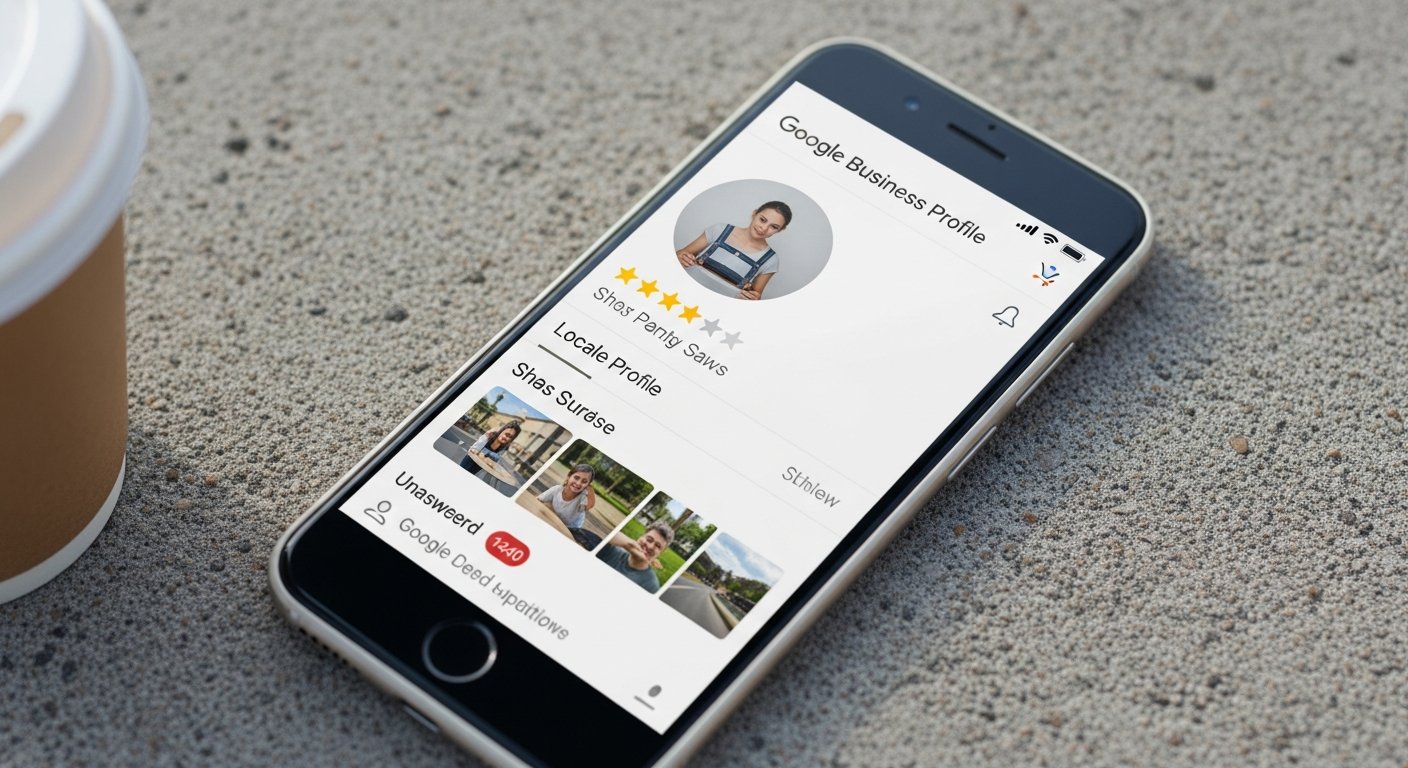
Before a customer calls you, books with you, or walks through your door, they almost always do one thing first: they look you up on Google. Not your website. Not your Instagram. Google. Specifically, the Business Profile panel that appears on the right side of the screen or at the top of a mobile search.
This profile is your digital front door. It shows your hours, your photos, your reviews, your phone number, and a snapshot of who you are as a business. In many cases, it is the only thing a potential customer sees before they decide whether to contact you or scroll to your competitor.
That makes it one of the most revenue-critical assets your business owns. And yet most SMB owners treat it like a one-time setup task rather than an active, living part of their marketing system.
If your Google Business Profile were a salesperson, most profiles would have been fired years ago.
The result is a quiet, ongoing profit gap. Not a dramatic failure you can point to. Just a steady, invisible leak. Customers who found you, looked at your profile, and decided not to reach out. You never knew they were there. You never knew they left.
The Four Profit Gaps That Live Inside Most Profiles
After running diagnostic assessments across hundreds of small and mid-sized businesses, the same breakdowns appear in the same places. Here are the four that show up most often. And the revenue logic behind each one.
1. Incomplete or outdated business information. Missing hours, wrong phone numbers, no website link, no service area defined. This sounds basic, but incomplete profiles are penalized by Google's ranking algorithm and abandoned by customers the moment they hit a dead end. If a customer cannot confirm your hours in under five seconds, they move on.
2. A thin or stale photo library. Google's own data shows that businesses with more than 100 photos receive 520% more calls than those with fewer than ten. That is not a small edge. That is a categorical difference. Photos signal that a real, active business is operating here. A profile with three blurry photos from 2021 signals the opposite.
3. Review volume and response patterns. Reviews are trust infrastructure. A business with 12 reviews and a 4.2 average will almost always lose to a competitor with 80 reviews and a 4.0 average. Volume signals legitimacy. But the response pattern matters just as much: owners who reply to reviews. Especially negative ones. Demonstrate accountability and customer care in a way that raw star ratings cannot. Silence on a bad review is a conversion killer.
4. No Q&A content and no posts. Google Business Profiles include a Q&A section that almost no SMB owner actively manages. Left unattended, anyone can post a question. And anyone can answer it. Incorrect answers from random users appear on your profile as if they are official. The Posts feature, which functions like a mini feed on your profile, is equally underused. Both are free visibility tools that most businesses leave completely dark.
What Google's AI Overviews Change About This Equation
Here is where the stakes just got higher.
Google's AI Overviews. The AI-generated summaries that now appear at the top of many search results. Are actively reshaping which businesses get seen and which ones disappear. Early data suggests that roughly 38% of click behavior has shifted toward AI-surfaced results, meaning that organic positions that used to reliably drive traffic are delivering less than they did twelve months ago.
For businesses with strong, complete, actively managed Google Business Profiles, this shift is manageable. Google's AI systems pull from structured, verified business data when building these summaries. A complete profile with consistent information, high review volume, and active engagement signals is more likely to be surfaced accurately.
For businesses with incomplete or neglected profiles, the AI Overviews update is effectively an amplifier of existing problems. If your profile already had gaps, those gaps are now more expensive. The customers you were losing quietly before are now being redirected to competitors at a faster rate.
This is a visibility profit gap in its purest form. You are not being penalized for anything you did wrong. You are being passed over because your profile does not signal trustworthiness the way a well-maintained one does. And Google's AI is making that judgment call on your behalf, at scale, before a human ever sees your listing.
The Credibility Layer Most Owners Miss Entirely
There is a second dimension to this problem that goes beyond completeness and photos. It is the credibility layer. The signals on your profile that tell a stranger whether they can trust you with their money.
Visibility gets you found. Credibility determines whether the person who found you actually calls.
Think about what a skeptical customer is looking for when they pull up your Google Business Profile. They are not just confirming your hours. They are running a quick mental risk assessment. They are asking: does this business look like it has its act together? Have other people had good experiences here? Is someone actually minding the store?
Every unanswered review, every missing photo, every stale post, every blank attribute field is a small credibility deduction. Individually, none of them are fatal. Together, they create a profile that feels like a business that does not care. Even if the actual business is excellent.
This is the trap. A genuinely great business with a neglected Google profile loses to a mediocre competitor with a well-maintained one, every single time. The profile is not a reflection of your quality. It is a signal of your attentiveness. And customers cannot tell the difference until after they have already chosen someone else.
How to Audit Your Own Profile in Under 20 Minutes
You do not need a marketing agency to run a basic diagnostic on your Google Business Profile. Here is a structured review you can do yourself. Right now. That will surface the most common profit gaps.
Step 1: Search your business name on Google. Do not go to the Business Profile dashboard. Search the way a customer would. Look at what they see. Is the information accurate? Are the photos current? Is the first review they read positive or negative?
Step 2: Score your photo count. Count the total photos on your profile. If you have fewer than 25, that is a gap. If you have fewer than ten, that is a revenue problem. Add a minimum of ten new, high-quality photos this week: your storefront, your team, your work in progress, your finished product.
Step 3: Read your last ten reviews and check your response rate. Did you respond to all of them? Did you respond to the negative ones professionally and specifically. Not with a defensive template? Review response rate is a ranking signal and a trust signal simultaneously.
Step 4: Open the Q&A section. Are there unanswered questions? Are there questions with incorrect answers from non-staff? Address all of them. Then proactively add your own Q&A pairs covering the questions you get asked most often.
Step 5: Check your last Google Post. When was it published? If it was more than 30 days ago, your profile is showing a stale activity signal. Post a minimum of once per week. A promotion, a team update, a service highlight, a recent review callout.
This five-step review will not take you more than 20 minutes. It will surface the gaps. Closing them is another matter. But you cannot fix what you have not named.
Why This Is Only One of Nine Places Revenue Leaks
Your Google Business Profile is a visibility and credibility asset. Fixing it will improve how many people find you and how many of those people decide to reach out. That is real, measurable revenue impact.
But it is one dimension of a much larger diagnostic picture.
FreshThink's Profit Gap IQ Report scores your business across nine revenue-critical factors. Not just your Google presence, but your full visibility footprint, your credibility signals across platforms, and your conversion infrastructure. The diagnostic is built manually by our team, not auto-generated, and delivered within 24 hours. You get a scored report, not a vague summary, and a short review call to walk through exactly what to fix and in what order.
Most businesses that go through the diagnostic find at least four gaps they were not aware of. Some find seven. The ones that sting the most are always the ones that have been quietly bleeding revenue for months without a single visible warning sign.
The Google Business Profile gap is almost always in the report. So are the ones you have not thought to look for yet.
Conclusion: Stop Guessing Where the Leak Is
You built a real business. You deliver real value. You deserve marketing that reflects that. And a clear picture of where the disconnect is happening between the quality of what you do and the results your marketing is producing.
The Google Business Profile problems described in this article are fixable in a single afternoon. But they are also a symptom of a larger pattern: most SMB owners are operating without a diagnostic map of their own marketing. They are running on instinct and hope, spending on tactics without a clear read on which of the nine revenue dimensions are actually failing them.
That is the problem FreshThink was built to solve. Not with another service package or another campaign promise. But with a scored, specific, AI-powered diagnostic that tells you exactly where your revenue is leaking before you spend another dollar trying to fix it.
Get your free Profit Gap IQ Report at freshthink.com. Delivered in 24 hours. No agency pitch attached.

David Matthies
Co-Founder
David Matthies is Co-Founder of FreshThink and SparkIQ, an AI marketing agency that helps small and mid-sized businesses identify exactly where revenue is leaking before recommending how to fix it. His work centers on replacing guesswork with structured diagnostics — giving business owners a clear picture of what is actually driving or blocking growth. He writes about the gap between marketing effort and revenue results, and how data-driven analysis changes the decisions businesses make.
More from David Matthies →