Why Your Ads Get Clicks But Never Convert
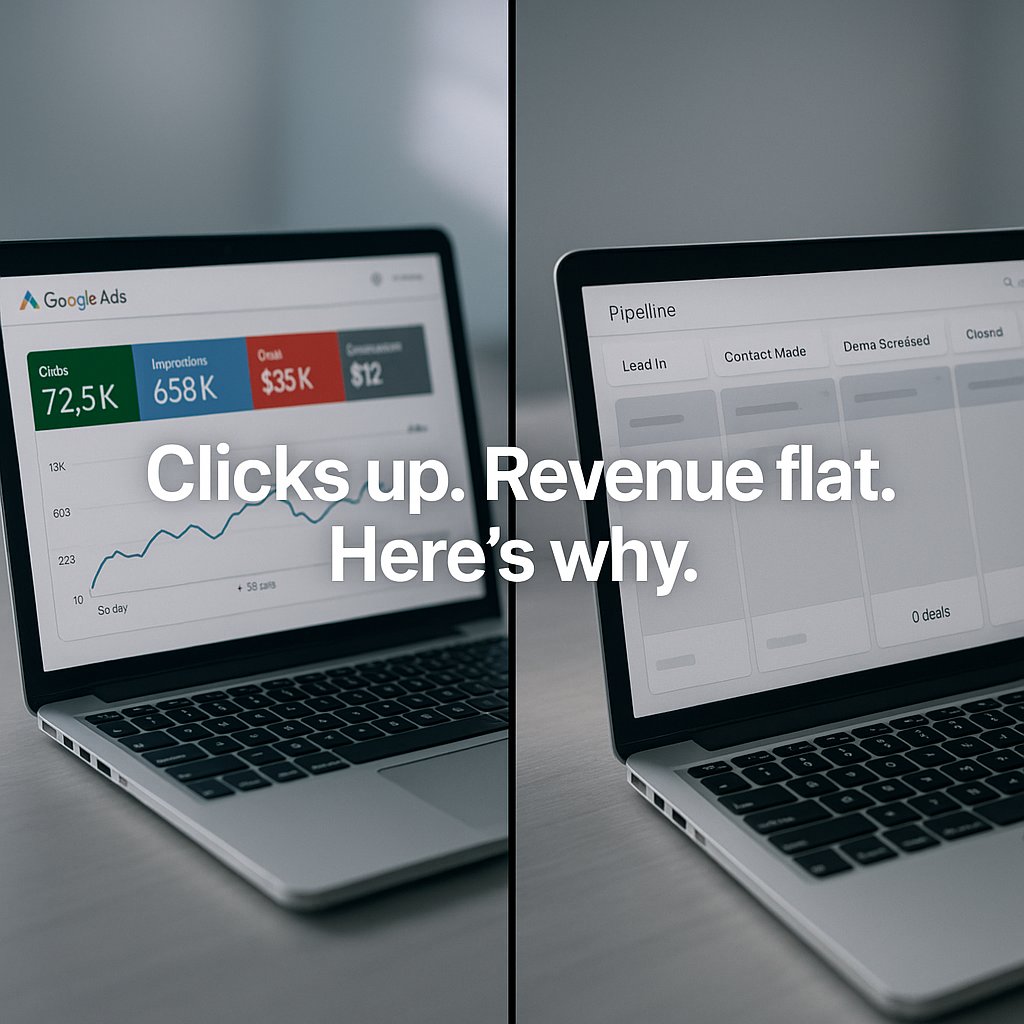
You open your ad dashboard and the numbers look fine. Clicks are up. Impressions are solid. Cost-per-click is where your agency said it should be. Then you look at your sales pipeline and it's empty. You've been here before. You're spending real money and getting digital applause. Traffic that shows up, looks around, and leaves without buying anything.
This is not bad luck. It is not a slow market. It is a diagnosable problem with a specific name: a conversion profit gap. And until you identify exactly where the breakdown is happening, you will keep funding it.
The Click Is Not the Win. The Sale Is.
Most small business owners are taught to measure marketing by activity. Clicks, impressions, reach, engagement. These metrics feel like progress because they move in the right direction when you spend money. But they are not revenue. They are signals. And signals only matter if you know what they're telling you.
A click means someone was curious enough to leave what they were doing and visit your page. That's it. What happens next is determined entirely by what they find when they arrive. And most businesses have never audited that experience with any rigor. They assume the ad is the problem when the ad did exactly what it was supposed to do. It got the click. The rest of the funnel failed.
This is the first diagnostic distinction every business owner needs to make: is the problem upstream (no one sees you) or downstream (people see you and leave)? Confusing the two is expensive. Fixing visibility when you have a conversion problem is like renovating your storefront when the staff inside is turning customers away.
The Three Places Your Conversion Is Leaking
When clicks don't become customers, the breakdown almost always lives in one of three places.
The trust gap. Your ad made a promise. Your landing page didn't back it up. Visitors landed on a page that felt generic, slow to load, thin on proof, or mismatched with what the ad said. In 2026, buyers make trust decisions in under three seconds. If your page doesn't immediately signal that you are credible, specific, and safe to do business with, they leave. No amount of retargeting fixes a trust gap. You have to earn it at the point of arrival.
The message gap. Your ad spoke to one pain. Your landing page spoke to a different one. Or to no specific pain at all. This misalignment is more common than most owners realize, especially when ads are managed by one person and the website was built by someone else two years ago. The visitor's brain is looking for confirmation: yes, I'm in the right place, this is for me. If the message doesn't match, that confirmation never arrives and neither does the sale.
The friction gap. Your page is fine. Your offer is clear. But the path to saying yes has too many steps, too many form fields, too many decisions, or too much ambiguity about what happens next. Friction is the silent killer of conversion. A buyer who is 80% ready to act will abandon the process if the last 20% is confusing or inconvenient. One extra click. One unclear button. One form that asks for information they don't want to give. Any of these can kill a conversion that was already in motion.
Why Your Agency Isn't Catching This
Here's the uncomfortable truth about most marketing agency relationships: agencies are measured on the metrics they control. They control ad spend, creative, targeting, and delivery. They do not control what happens on your website after the click. They do not own your CRM, your follow-up sequence, your sales team's response time, or the credibility signals on your landing page.
So when conversions are low, the default response is to optimize the ad. Change the creative. Adjust the audience. Test a new headline. And sometimes that helps. But often, the ad was never the problem. The problem was downstream, in a part of the funnel the agency was never accountable for.
This is not an accusation. It is a structural reality. Traditional agencies are built to execute, not to diagnose. They were hired to run campaigns, not to audit the entire revenue path from first impression to closed deal. And without a diagnostic framework that looks at the full picture. Visibility, credibility, and conversion together. The real problem stays invisible.
What a Real Conversion Diagnosis Looks Like
Diagnosing a conversion problem is not about running more A/B tests or installing a heatmap tool. Those are tactics in search of a strategy. A real diagnosis starts with a structured audit of every factor that influences whether a visitor becomes a buyer.
At FreshThink, we built the Profit Gap IQ Report specifically to answer this question: where, across nine specific dimensions of customer acquisition, is your business losing revenue? The three diagnostic pillars are visibility (can buyers find you?), credibility (do they trust what they find?), and conversion (does your marketing actually close?).
Each pillar contains multiple scored factors. Not vague observations. Actual scores that tell you exactly how you are performing against each dimension and where the gap is costing you money. A business can score well on visibility and poorly on credibility. Another might have strong credibility but a conversion path so fragmented that buyers drop off at the last step. The combination is always specific to the business. Generic advice cannot fix a specific problem.
The report is built manually by our team, delivered within 24 hours, and reviewed on a short call so you are not left interpreting data alone. You walk away knowing exactly what is broken, in what order to fix it, and why the clicks you have been paying for have not been turning into revenue.
The Diagnostic Question You Should Ask Right Now
Before you adjust your ad budget, change your creative, or fire your agency, ask one question: have I ever had a structured, scored audit of all three dimensions of my customer acquisition. Not just my ad performance, but my credibility signals and my conversion path together?
If the answer is no, you have not diagnosed the problem. You have been treating symptoms.
Here is a simple self-assessment to start:
- Does your landing page load in under three seconds on mobile?
- Does the headline on your landing page match the promise in your ad?
- Do you have at least three trust signals visible above the fold. Reviews, credentials, specific results, or named proof?
- Is your call to action a single, unambiguous next step?
- Do you have an automated follow-up sequence that contacts a new lead within five minutes of opt-in?
If you answered no to two or more of these, you have a conversion profit gap. The clicks are working. The funnel is not.
The Real Cost of Not Diagnosing
Every month you run ads without diagnosing the conversion gap, you are paying twice. Once for the traffic that arrived and left. Once for the opportunity cost of the revenue those visitors could have become.
For most SMBs spending between $2,000 and $10,000 a month on digital advertising, the undiagnosed conversion gap represents a significant portion of that spend being wasted. Not because the ads are bad, but because no one has ever looked at the full picture and identified exactly where the money is disappearing.
The most expensive marketing mistake is not running a bad ad. It is not knowing which part of your marketing is broken before you spend another dollar on it.
Fix the Diagnosis Before You Fix the Ad
If your ads are getting clicks and your sales are not moving, stop optimizing the ad. Start diagnosing the funnel.
Get specific about where the breakdown is happening. Map the full path from first impression to closed sale. Score each stage against the factors that determine whether a visitor becomes a buyer. Then fix what the data shows is broken. Not what your agency says they can improve, not what a competitor is doing, and not what worked for someone else's business in a different market.
This is the difference between marketing as a cost center and marketing as a growth engine. One burns money in the direction of activity. The other invests money in the direction of evidence.
FreshThink's Profit Gap IQ Report gives you that evidence in 24 hours. Nine factors. Three dimensions. One scored, specific, actionable picture of exactly where your revenue is leaking. And what to do about it.
Get your free Profit Gap IQ Report at freshthink.com. Stop guessing. Start knowing.

David Matthies
Co-Founder
David Matthies is Co-Founder of FreshThink and SparkIQ, an AI marketing agency that helps small and mid-sized businesses identify exactly where revenue is leaking before recommending how to fix it. His work centers on replacing guesswork with structured diagnostics — giving business owners a clear picture of what is actually driving or blocking growth. He writes about the gap between marketing effort and revenue results, and how data-driven analysis changes the decisions businesses make.
More from David Matthies →